Solutions · Farms
Solar camera for farm security
A solar camera for a farm has to work where there is no power line and no Wi-Fi, through the rainy season, on a data bundle the farmer can afford. This is how we lay one out: what to watch, which model goes where, and how to size the power.
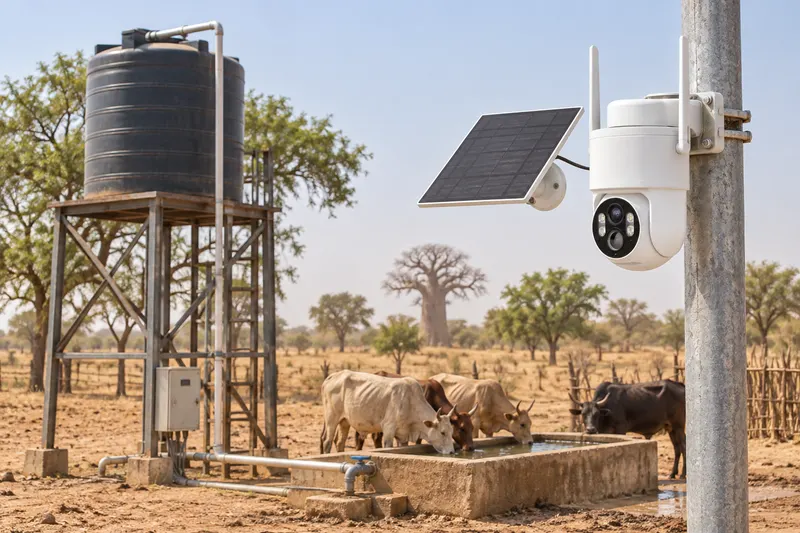
Start from where theft happens
Farm theft follows the same routes: through the main gate or a gap in the fence, to the animal shelter, the pump, the fuel or the store. A solar camera for farm use earns its cost when it watches those points, not when it shows a pretty view of the fields. Walk the farm and mark:
- Gates and the gaps in the fence that vehicles or animals can pass.
- Where animals sleep at night: kraal, boma, shed or pen.
- Pumps, boreholes, solar pump controllers, cables and tanks.
- Stores for feed, fertiliser, fuel and harvested crops.
Which camera goes where
| Spot | Model | Why |
|---|---|---|
| Main gate and yard | SV-D2 dual-lens | Gate always in view, second lens follows |
| House, borehole, small yard | SV-P1 PTZ | One camera turns to cover the area; panel can go in the sun |
| Poultry house, sunny wall | SV-P2 all-in-one | Panel on top, one bracket to fit |
| Store door, pump house | SV-B1 bullet | Fixed view, colour night LEDs, no motor |
| Large yard with several approaches | SV-M3 multi-lens | Several views from one pole and one SIM |
| Grazing land, water point, fence line | SV-H1 trail camera | Camouflaged, 25 m PIR, photos to the phone |
Mounting: height, angle and sun
Mount cameras 3–5 m high on a steel pole or a solid wall. Higher is harder to reach and sees over fences and crops; too high and faces become the top of a head. Point the panel towards the equator side of the sky: in Kenya, which sits on the equator, a nearly flat panel tilted slightly to shed rain works; in Nigeria and Ghana, tilt it towards the south. Keep it out of the shadow of trees, roofs and the pole itself for most of the day.
Check the 4G signal at the mounting point with a phone on the same network before drilling. One bar of 4G is enough for alerts and short clips; live viewing needs more.
Power through cloudy weeks
A solar camera spends most of its time asleep and wakes on motion. Its battery needs to cover nights plus the cloudy days in a row your area gets in the rainy season. Panel watts and battery watt-hours are printed on our datasheets together with our measured run time with no sun. For sites under trees, or with long rainy seasons, order the extension panel.
Data and the monthly bill
Alerts and short clips use little data; watching live uses most of it. Set the camera to record to the SD card and send alerts, then watch live only when an alert comes in. The SIM card guide has a worked example of monthly data use.
Night-time livestock
Livestock theft needs its own plan: night vision range, lights and sirens, and coverage of loading points. See cameras against livestock theft. For country details see Kenya, Nigeria and Ghana, or return to the solar 4G camera range.
Farm solar camera questions
How many solar cameras does a farm need?
Count the places where theft starts, not the acres: each gate, the pump or borehole, the store and the animal enclosure at night. Most small farms start with two: a dual-lens camera at the main gate and a fixed camera on the pump.
Will a solar camera work through the rainy season?
If the panel and battery are sized for it. Ask for the run time with no sun on the datasheet, and add the extension panel for sites with long cloudy spells.
Can the camera scare thieves away?
Our PTZ models have a siren, lights and two-way talk that can be set to trigger on human detection. A visible camera on a tall pole is also a deterrent by itself.
Is there a monthly cost?
The data bundle on the SIM. Cloud recording may also be a paid option in the app; recording to the SD card is free.