Article ·
CCTV certification in India: BIS, STQC and TEC for a 4G camera (2026)
CCTV certification in India is the first question for any importer or brand planning to sell cameras there. Three schemes come up: BIS registration, which lists CCTV cameras and recorders; STQC security testing against MeitY’s Essential Requirements; and TEC’s MTCTE for equipment that connects to the Indian telecom network. This guide sets out what each official document says, as read on 1 November 2026, and what is still for you to confirm for a 4G solar camera. It is not legal advice.
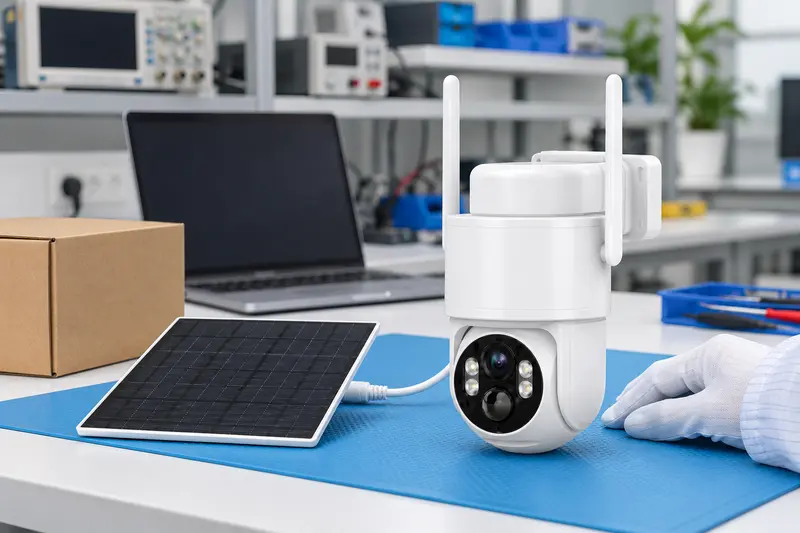
The three schemes at a glance
| Scheme | What the document says | Validity |
|---|---|---|
| BIS Compulsory Registration Scheme | The BIS list of products under the scheme includes “CCTV Cameras/CCTV Recorders”, against IS 13252 (Part 1):2010 and “Essential Requirement(s) for Security of CCTV”.[1] | See BIS for the registration term |
| STQC CCTV certification (IoTSCS) | Test laboratories test CCTV cameras against the Essential Requirements in the MeitY gazette notification of 6 March 2024; the manufacturer submits a Technical Construction File.[2] | Three years from issue, subject to surveillance audit[2] |
| TEC MTCTE | Applies to telecom and ICT equipment sold in India that connects, or can connect, to the Indian telecom network; Phase III and IV mandatory from 1 July 2022.[3] | Five years, renewable[3] |
Read on 1 November 2026. Lists and notifications change; check the BIS, STQC and TEC portals before you apply.
BIS: CCTV cameras are on the CRS list
The Bureau of Indian Standards publishes the list of products covered by its Compulsory Registration Scheme. Row 41 reads “CCTV Cameras/CCTV Recorders”, with the standard IS 13252 (Part 1):2010 and, next to it, “Essential Requirement(s) for Security of CCTV”.[1] IS 13252 (Part 1) is the safety standard the same list uses for other IT equipment such as visual display units and barcode readers.[1] So the CCTV line asks for two things: electrical safety and security.
The BIS portal sets out how a foreign manufacturer applies, which laboratories can test, and what registration costs. We have not summarised those rules here because we did not read them in full; read them on the BIS CRS portal before you plan.
STQC: the security part
STQC, a directorate of the Ministry of Electronics and Information Technology, runs the IoT System Certification Scheme. Its procedure P01 for CCTV cameras, issued 21 May 2024, describes how a manufacturer gets a camera certified against the security Essential Requirements.[2] In short:
- Map the supply chain.The manufacturer identifies the entities that design, make, check and supply chips for the camera, in an entity relationship diagram.[2]
- Build the security features.Secure boot, secure firmware update, a crypto library and test cases, as listed in the Essential Requirements.[2]
- Prepare the Technical Construction File (TCF).The artefacts the Essential Requirements ask for, plus the boards and tools a lab needs to test them.[2]
- Apply to STQC.The certification body reviews the TCF and may call a technical review; it then gives an application number to the test laboratory.[2]
- Testing and witness.The lab tests the samples and the manufacturer demonstrates the security functions; an assessor oversees the work on behalf of the certification body.[2]
- Certificate.Issued to the developer or manufacturer, valid for three years subject to surveillance audit.[2]
Both the BIS line and the STQC procedure point to security Essential Requirements for CCTV. Ask your test lab which security report BIS will accept for your model before you start.
TEC MTCTE: when the camera has a SIM
A 4G camera is a SIM device. TEC’s Mandatory Testing and Certification of Telecommunication Equipment covers equipment that connects, or can connect, to the Indian telecom network, and an OEM, importer or dealer must get a TEC certificate and put the TEC label on notified equipment before it goes on sale.[3] Certification is model-based: up to 10 family models can be added without further testing, and the certificate is valid for five years.[3] Testing is done in TEC-designated laboratories.[3]
What we could not confirm: whether a 4G CCTV camera falls under a notified MTCTE category, or whether the 4G module’s own certificate is enough. The summary we read does not list CCTV cameras, and points to the full product list on TEC’s website.[3] Check that list, or ask a TEC-designated lab, with the module part number in hand.
What this means if you import from a factory
- Certificates follow the model.A certificate is for a specific camera model. Changing the chipset, the 4G module or the firmware can mean a new test.
- The manufacturer has to take part.The STQC route needs supply-chain details, secure-boot code and demo boards that only the maker has.[2] Agree before ordering who pays for testing and who holds the certificates.
- Plan the time.Three separate schemes, each with its own lab and portal. Budget months, not weeks, before the first legal sale.
Where Solvigil stands
Our solar 4G cameras do not hold BIS registration, STQC certification or a TEC certificate today, so they cannot be sold in India as they are. That is why we have no India page yet: we will add one only if a model is certified. If you are an Indian brand or importer planning your own certification of a camera such as the solar 4G PTZ camera (S49), contact us to discuss what the process would need from the factory. For a similar SIM-device rule elsewhere, see our NCC type approval and IMEI guide for Nigeria; for the region, see the Pakistan page.
Questions people ask
Is BIS registration mandatory for CCTV cameras in India?
CCTV cameras and recorders are on the BIS list of products under the Compulsory Registration Scheme, so they need registration before sale.[1]
What is STQC certification for CCTV?
It is security testing under STQC’s IoT System Certification Scheme, against the Essential Requirements in MeitY’s 6 March 2024 notification. The certificate lasts three years with surveillance audits.[2]
Does a 4G CCTV camera need TEC certification?
Possibly. MTCTE applies to notified equipment that connects to the Indian telecom network.[3] Check TEC’s current product list for your camera and its 4G module.
Can I sell an uncertified camera in India?
Not legally, if the product is on a mandatory list. Get the certificates first.
Sources
- Products covered under the Compulsory Registration Scheme. Bureau of Indian Standards. Read 1 Nov 2026.
- P01 — Procedure for CCTV testing, evaluation and certification (STQC/IoTSCS/P01). STQC Directorate, MeitY, 21 May 2024. Read 1 Nov 2026.
- Mandatory testing and certification for telecommunication equipment in India. UL Solutions. Read 1 Nov 2026.
More articles
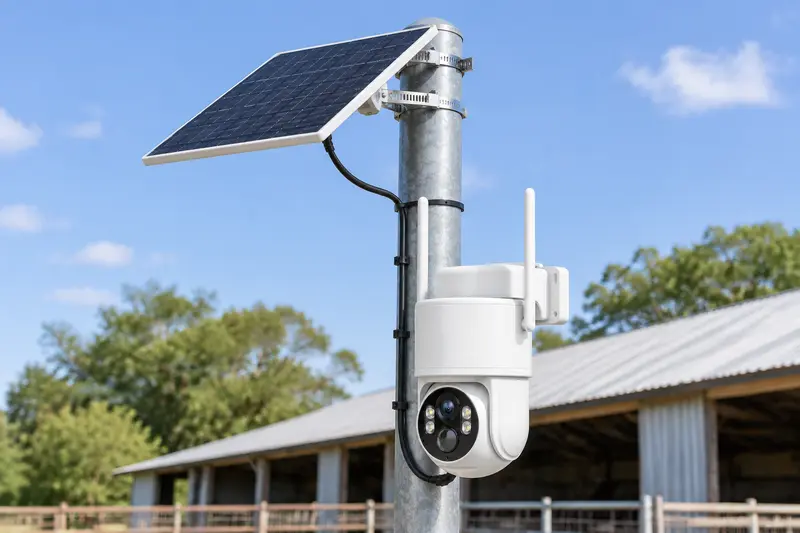
How to mount a separate solar panel for a CCTV camera
How to mount a solar panel for a CCTV camera: where it goes on the pole, which way it faces, the tilt, clamping, cable routing, drip loop and panel sizes per model.
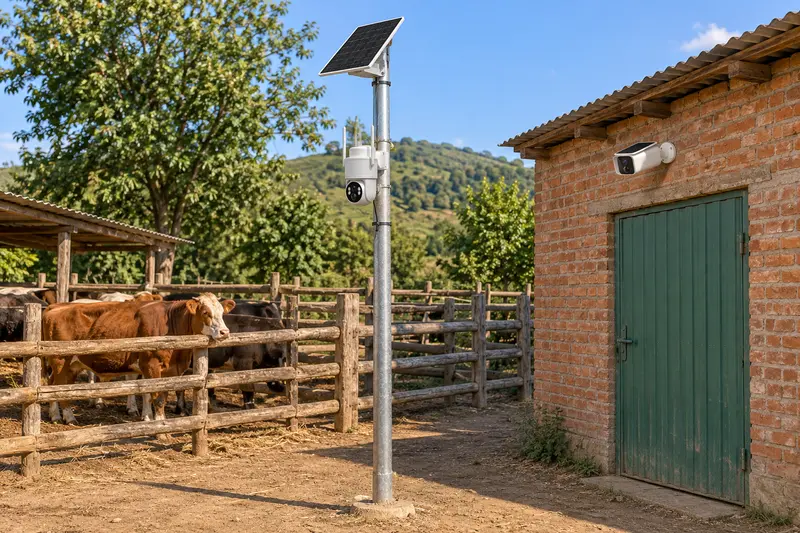
PTZ vs bullet camera on a farm: which solar 4G camera goes where
PTZ vs bullet camera on a farm: how a pan-tilt S49 and a fixed S26 bullet differ in view, night range, solar panel and price, and which suits a gate, a pen or a store.
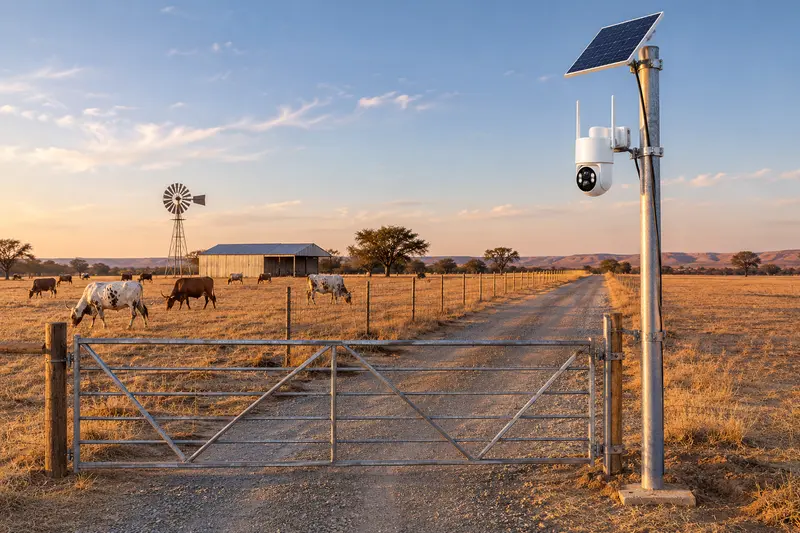
Farm security systems in South Africa: solar 4G PTZ cameras without Wi-Fi
Farm security systems in South Africa: why livestock theft and cable theft now matter more than load shedding, and how solar 4G PTZ cameras watch gates, kraals and pumps.