Article ·
Solar farm cable theft in the UK: 4G solar cameras for remote sites
Solar farm cable theft in the UK has become organised crime. Industry crime analysts reported 169 offences against solar, onshore wind and battery storage sites in 2025, a 59% rise on the year before, and copper prices have risen by around 25% since late 2025. A solar farm is a long fence, few staff and kilometres of string cable, often a long way from anyone. This article sets out what the published figures show, how thieves work a site, and where a 4G solar camera with its own power fits into a security plan. It is written for installers, security integrators and distributors.
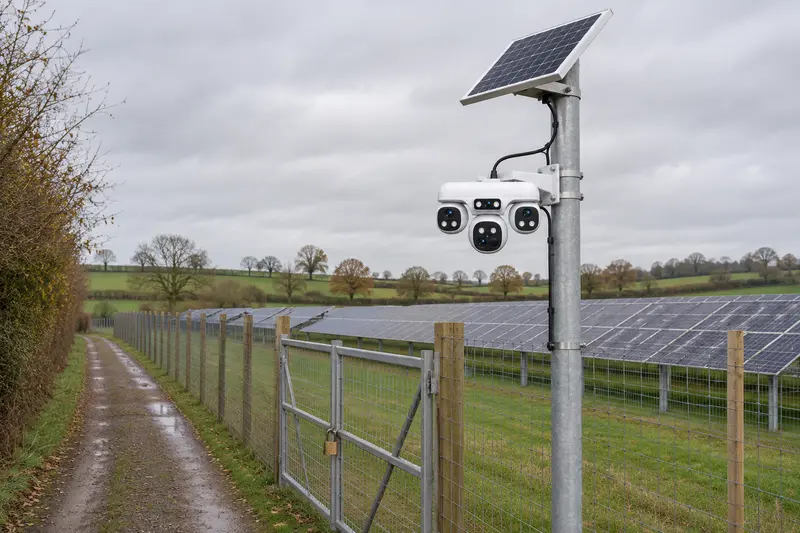
What the figures show
| Item | Reported |
|---|---|
| Offences in 2025 | 169 reported offences against solar, onshore wind and battery storage facilities, up 59% year on year, according to crime analysts quoted by Energy Global in June 2026.[1] |
| Copper price | Up around 25% since late 2025, which the same analysis says increases the incentive for theft.[1] |
| Outlook | The most recent data, shared with police forces in England and Wales, points to the trend continuing through 2026.[1] |
| Spring 2025 example | 11 incidents at UK solar sites in March and April 2025, against 3 in February, across seven counties; one site was broken into three times in a month and lost string cable valued at around £90,000.[2] |
The spring 2025 figures are from Solar Power Portal, 1 May 2025, and are given as an example of the pattern, not as this year’s numbers.
How thieves work a solar farm
- String cable first: analysts quoted by Solar Power Portal say string cable is the most common target, and with often more than 100 panels in a row, a kilometre of cable can be pulled quickly.[2]
- Testing the response: before a larger theft, gangs typically test a site by cutting a hole in the fence or knocking down a CCTV camera, and a site that has been hit once is likely to be hit again.[2]
- Decoys: in one Derbyshire case, mobile patrols were lured to a decoy location while cable was taken.[2]
- Farm tracks and gates: many sites have tracks near the fence reached through farm gates; removed padlocks and chains are an early warning sign.[2]
The losses go beyond the cable: a row without strings stops generating, and operators can face penalties under their power agreements.[2]
Where a 4G solar camera fits
A camera that depends on the site’s own cabling or network goes down with it, and a camera knocked down as a test tells no one unless it was sending alerts. A 4G solar camera runs on its own panel and battery and sends alerts and video over a data SIM, so it keeps working when the site’s cables are cut. It is one layer, alongside fencing, marking and a response plan, not a replacement for them.
- Gates and farm tracks: the dual-lens solar 4G camera (SQ62) keeps one lens fixed on the gate while the other follows a vehicle or person.
- Long fence lines and inverter areas: the multi-lens solar 4G camera (SQ41) has three moving heads and one fixed lens, with a 12,000 mAh battery.
- Watching the cameras: place cameras so each one is in view of another; then a camera that is knocked down is itself recorded.
Practical points for UK sites
- Check 4G at each pole.Use a phone on the network you will use; rural coverage varies field to field. Tell us the network and we check the module’s bands before shipping.
- Own poles, out of reach.About 4 metres up, separate from the site’s fence posts and cable routes, with the panel facing south and clear of shade.
- Alerts to people who respond.Send detections to the operator, the maintenance contractor and the monitoring company, and agree who acts at night.
- Winter light.Short UK winter days mean less charge; use event recording rather than continuous live viewing.
For UK installers and distributors
We are the factory and sell from 100 units, mixed models allowed, in US dollars FOB China. We have not confirmed that our current documentation meets every requirement for selling these radio devices in Great Britain, including whether our CE documentation covers EN 18031; the importer confirms conformity before selling, and we supply the test reports for the exact model. See our wholesale terms and price list.
Questions
How common is cable theft from UK solar farms?
Crime analysts reported 169 offences against solar, onshore wind and battery storage sites in 2025, up 59% on the year before.[1]
What do thieves take from solar farms?
Mainly copper string cable, which can be pulled along whole rows of panels.[2]
Does a 4G solar camera need power or broadband on site?
No. It runs on its own solar panel and battery and uses a 4G data SIM, so it keeps working if the site’s cables are cut.
Sources
- Securing the solar surge. Energy Global, 17 Jun 2026. Read 12 Nov 2026.
- UK entering ‘peak period’ of solar PV theft by ‘fully industrialised’ criminal network. Solar Power Portal, 1 May 2025. Read 12 Nov 2026.
More articles
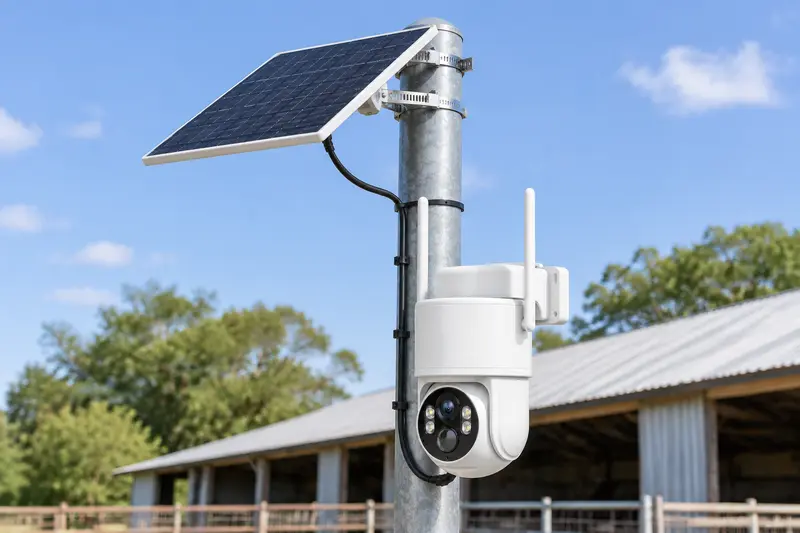
How to mount a separate solar panel for a CCTV camera
How to mount a solar panel for a CCTV camera: where it goes on the pole, which way it faces, the tilt, clamping, cable routing, drip loop and panel sizes per model.
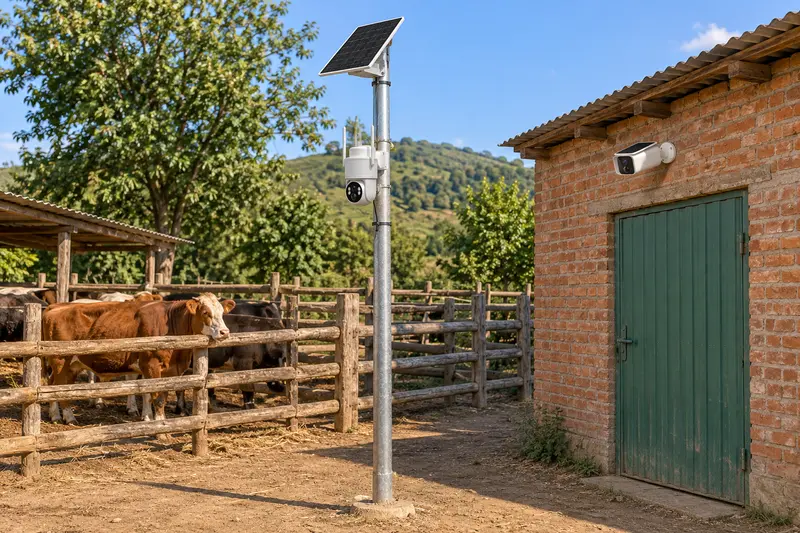
PTZ vs bullet camera on a farm: which solar 4G camera goes where
PTZ vs bullet camera on a farm: how a pan-tilt S49 and a fixed S26 bullet differ in view, night range, solar panel and price, and which suits a gate, a pen or a store.
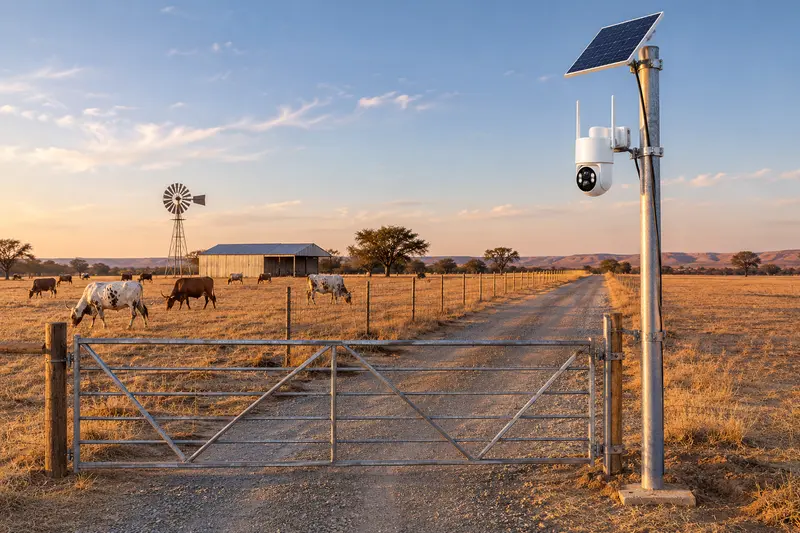
Farm security systems in South Africa: solar 4G PTZ cameras without Wi-Fi
Farm security systems in South Africa: why livestock theft and cable theft now matter more than load shedding, and how solar 4G PTZ cameras watch gates, kraals and pumps.