Article ·
4G vs Wi-Fi security camera for a farm
A 4G vs WiFi camera choice on a farm comes down to one question: is there a router with power and internet close to the spot you want to watch? Near the house, a Wi-Fi camera is cheap to run. At a gate, a borehole or a shed far from the house, only a camera with its own SIM card and its own power will stay online. This guide compares the two for farmers, installers and resellers, wherever you farm.
The short answer
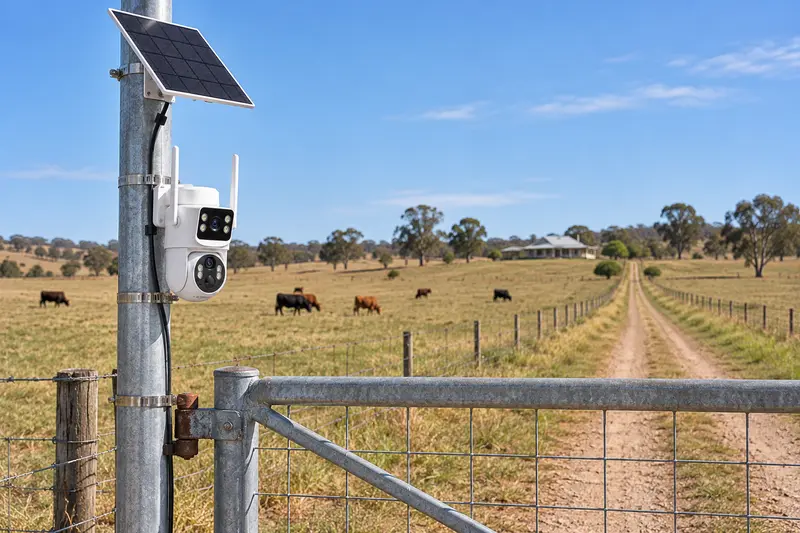
Use Wi-Fi cameras where your Wi-Fi already reaches and there is mains power: the house, the yard right beside it, a workshop with a router. Use a 4G camera with a solar panel everywhere else: the farm gate down the track, the borehole, the feed store across the field, a fuel tank, a paddock gate. Most farms end up with both, and that is fine, because they can live in the same phone app if you buy from the same range.
4G vs WiFi camera: side by side
| Question | Wi-Fi camera | 4G camera (with solar) |
|---|---|---|
| What it connects to | Your router, through the air | A mobile network tower, through a data SIM in the camera |
| How far from the house | Only as far as your Wi-Fi signal reaches, usually the house and the area just around it | Anywhere the mobile network has 4G coverage at the mounting point |
| Power | Usually a plug or a cable to a power point | Its own solar panel and battery; no cable |
| Monthly cost | Nothing extra if you already pay for home internet | A data bundle for each camera |
| When the power goes off | The camera and the router both stop, unless you have a backup supply | Keeps running on its battery and keeps recording to the microSD card |
| When the internet goes off | No alerts or live view; recording depends on the model | Not affected by your home internet; depends only on the mobile network |
| Set-up | Join the camera to your Wi-Fi in the app | Insert a SIM with data, scan the QR code, mount the camera and panel |
General comparison. The details of a particular Wi-Fi camera depend on its maker and your router.
Distance is the deciding factor
A farm is not a house. The things worth watching are spread out: the gate on the road, the borehole pump in the paddock, a store at the far end of the yard, cattle in a pen. Wi-Fi signals weaken fast through walls and over open ground, and every repeater or outdoor access point you add needs its own power. By the time you have run a cable or a power supply to the gate for a Wi-Fi bridge, you have spent more than the camera.
A 4G camera does not care how far it is from the house. What matters is the mobile signal at the mounting point. Before you choose, stand at the spot with a phone on the network you plan to use, at roughly the height the camera will be, and check that the phone shows 4G and can open a web page with Wi-Fi turned off.
Power: the hidden half of the decision
A camera needs both a connection and electricity. Near the house a Wi-Fi camera can plug in. Away from it, there is usually no socket at all. That is why farm 4G cameras come with a solar panel and a battery: the camera sleeps until motion wakes it, records, sends an alert and goes back to sleep, and the panel tops up the battery during the day.
Our solar 4G PTZ camera (S49) pairs a separate 5 W panel with a 7,800 mAh battery, and the all-in-one S53 carries a 3 W panel on top of the housing with the same battery. The panel and battery guide explains how to size them for cloudy weeks.
Running costs: data versus nothing
A Wi-Fi camera uses the internet connection you already pay for. A 4G camera needs its own data bundle, and that is the main ongoing cost. How much data depends on how you use it: recording to the microSD card uses no data at all, while alerts with snapshots use a little and long live viewing uses the most. Our SIM card guide has a worked example of monthly data use and tips on choosing a bundle that renews by itself.
For a farmer, the comparison is usually not data against nothing. It is data against the cost of trenching a cable, adding a Wi-Fi bridge with its own power, or driving out to check the gate at night.
Reliability when things go wrong
- Power cuts.When the grid goes down, a Wi-Fi camera and its router go down with it unless both sit on a backup supply. A solar 4G camera runs on its own battery, which is why farms in areas with frequent outages often choose them even near the house.
- Internet outages.A Wi-Fi camera cannot send alerts when the home connection drops. A 4G camera has its own link, so a fibre fault at the house does not affect it.
- Weak mobile signal.This is the one place 4G loses. Where the mounting point has no 4G, a 4G camera cannot send alerts, though it still records to its card. Check the signal first, and match the camera's band version to your network.
Bands: the 4G detail that catches people out
A 4G camera only connects on the radio bands its module supports. A phone may show strong 4G at the gate while a camera with a different band set shows nothing. Before buying, check which bands your network uses and which the camera supports. Our country pages list the bands for each network, for example in Australia, South Africa, the Philippines and Kenya, and we confirm the band version against your operator before shipping.
Which to choose, spot by spot
| Spot | Our suggestion |
|---|---|
| Front door, porch, house yard | Wi-Fi, if the router and a power point are close |
| Farm gate down the track | 4G with solar; a dual-lens camera keeps the gate in view while following a person |
| Borehole, pump or water tank | 4G with solar; a fixed bullet camera watches one point all the time |
| Feed store or machinery shed | Wi-Fi if it has power and a router in range, otherwise 4G with solar |
| Livestock pens and paddocks | 4G with solar, on a tall pole |
For resellers and installers
Farm customers often ask for "a camera that works without Wi-Fi" without knowing the term 4G camera. If you stock both, the rule of thumb above is an easy way to sell the right one. Solvigil is the source factory for solar 4G cameras: orders from 100 units in mixed models, prices in US dollars FOB China, and Wi-Fi versions of some bodies quoted on request. See the wholesale terms, compare all seven solar 4G camera models, or read our longer comparison of a solar 4G camera vs wired CCTV on a farm.
More articles
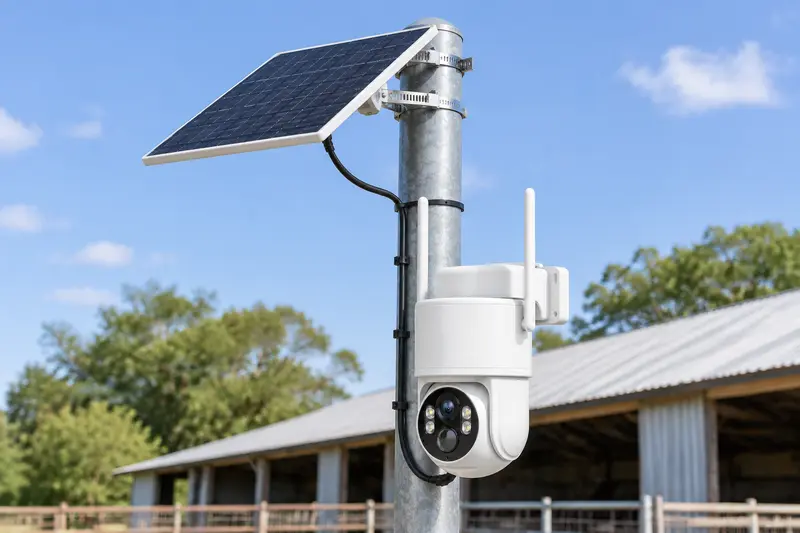
How to mount a separate solar panel for a CCTV camera
How to mount a solar panel for a CCTV camera: where it goes on the pole, which way it faces, the tilt, clamping, cable routing, drip loop and panel sizes per model.
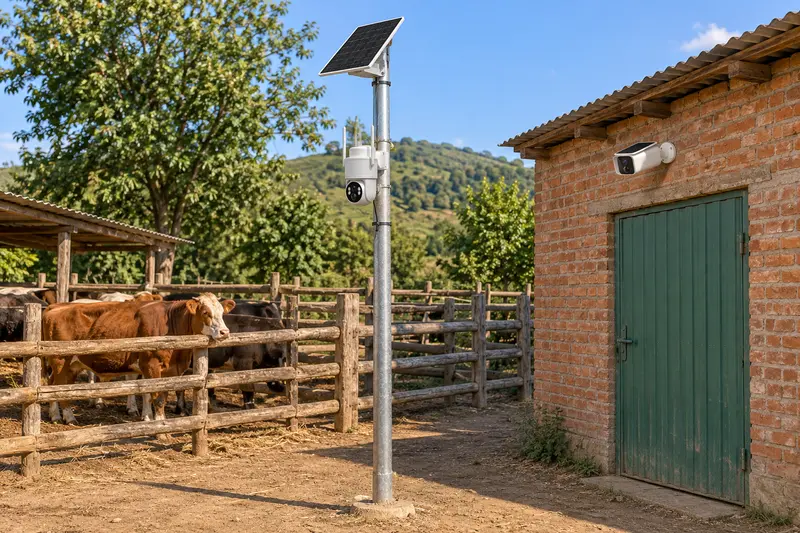
PTZ vs bullet camera on a farm: which solar 4G camera goes where
PTZ vs bullet camera on a farm: how a pan-tilt S49 and a fixed S26 bullet differ in view, night range, solar panel and price, and which suits a gate, a pen or a store.
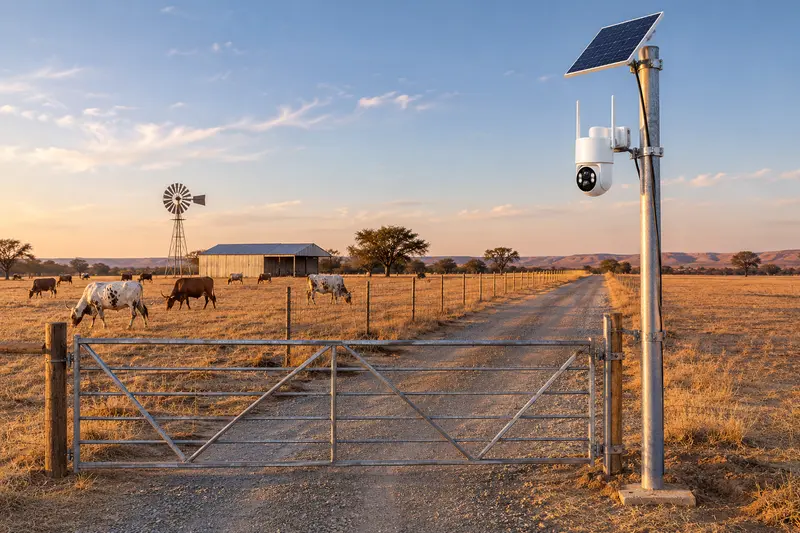
Farm security systems in South Africa: solar 4G PTZ cameras without Wi-Fi
Farm security systems in South Africa: why livestock theft and cable theft now matter more than load shedding, and how solar 4G PTZ cameras watch gates, kraals and pumps.