Article ·
Solar 4G camera vs wired CCTV on a farm: how to choose
A solar 4G camera vs wired CCTV is the first decision on most farm security jobs. The short answer: wired CCTV wins where there is mains power and internet close by; a solar 4G camera wins everywhere else. Here is how to decide point by point.
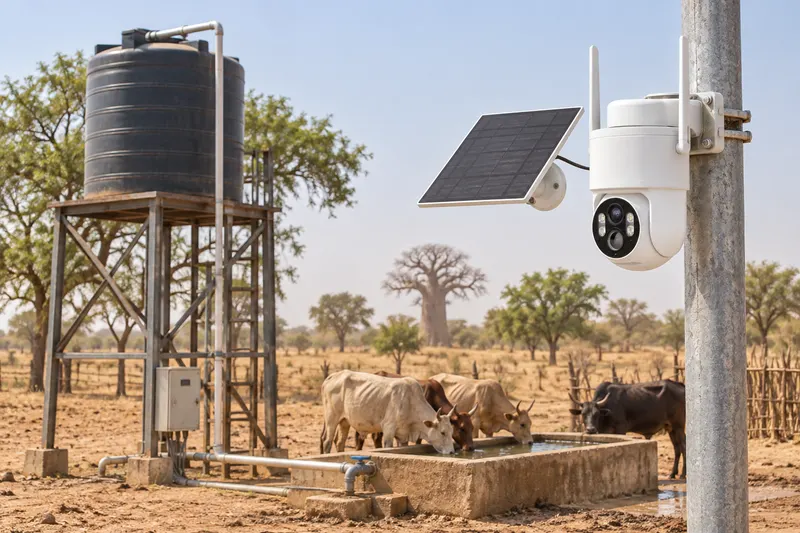
Side by side
| Solar 4G camera | Wired CCTV | |
|---|---|---|
| Power | Own solar panel and battery | Mains or a power supply at the recorder, cable to each camera |
| Internet | Its own 4G SIM and data bundle | Router or Wi-Fi at the recorder for remote viewing |
| Cables | Only panel to camera, on the same pole | A run to every camera; long runs add cost and are easy to cut |
| Recording | microSD card in each camera, optional cloud | One recorder (DVR/NVR) with a hard disk |
| Night | Infrared and white LEDs, battery-limited | Infrared, mains-powered |
| Running cost | Data bundle per camera | Electricity and one internet line |
| Moving it | Unbolt and refit in an hour | Re-cable |
When a solar 4G camera is the right choice
Choose solar 4G for anything more than a cable run from the house, or anywhere without reliable mains power: the farm gate, a borehole and pump, a fuel store, a grazing paddock, a construction site. Each camera is a complete system on one pole, so there is nothing to trench and no cable for a thief to cut. The trade-offs are that each camera needs a SIM and a data bundle, and that the battery limits how long it can stream live at night. Our panel and battery guide shows how to size that for a site.
When wired CCTV is the right choice
Choose wired CCTV where cameras sit around a building that already has mains power and internet: the farmhouse, a packhouse, an office or a shop. One recorder stores weeks of continuous video for every camera, and there is no data bundle per camera. The cost is in the installation: cable, trunking, a recorder with a hard disk, and labour.
Most farms end up with both
A common layout is wired cameras around the house and stores, and solar 4G cameras at the gate, the borehole and the far paddock. The phone app shows both, though usually in two apps unless the brands match. If you install for a living, quoting both in one proposal makes the reason for each camera clear to the customer.
Questions to ask before you choose
- Is there mains power within one cable run?If not, solar.
- Is there internet at that building?If not, a 4G SIM camera, or a 4G router for a wired system.
- Does 4G reach the exact spot?Test with a phone. No 4G means record to SD and check later, or choose another spot.
- Do you need continuous recording or alerts?Continuous favours wired; alerts and clips suit solar 4G.
- Who will maintain it?Solar needs a clean panel and a topped-up bundle; wired needs a working recorder and power.
To compare our solar models, see the solar 4G camera comparison, and for site layouts the farm security guide.
More articles
CCTV camera with solar panel: keeping watch through Nigeria’s power outages
Lagos lost power on 19 October and Enugu faces a six-day outage. Why wired CCTV goes dark in a blackout, and how a CCTV camera with a solar panel keeps recording.
Best CCTV camera for a shop in Nigeria when the power keeps going off
Choosing the best CCTV camera for a shop in Nigeria: what to cover, which cameras keep working when the power goes, wired versus wireless, and how to compare prices.
Does a CCTV camera work without electricity?
Does a CCTV camera work without electricity? A wired one stops without backup power; a solar 4G camera keeps recording. How long each lasts, with worked numbers.