Article ·
CCTV camera with solar panel: keeping watch through Nigeria’s power outages
On 19 October 2026 Nigeria’s power generation fell from about 3,840 MW to 477 MW in a few hours, and parts of Lagos, Abuja and Ogun lost supply. A week later the Enugu distribution company announced a planned six-day outage for communities around Nsukka. When the grid goes, most CCTV goes with it. Here is why, and what a CCTV camera with its own solar panel does differently.
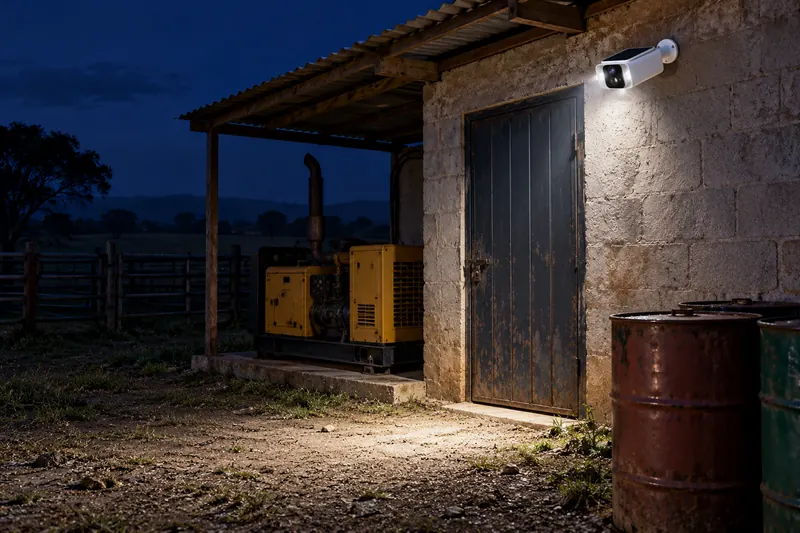
What happened to the power this month
On Monday 19 October, generation on the national grid fell by 87.59%, from 3,840 MW in the morning to 476.70 MW by 1 p.m., according to figures from the system operator’s monitoring portal reported by Pulse Nigeria.[1] The Nigerian Independent System Operator (NISO) denied a national grid collapse and blamed localised problems and plants tripping. Ikeja Electric told customers in Lagos they were getting fewer hours of supply because its allocation from the grid had dropped, and outages were also reported in Abuja and Ogun.[1]
On 26 October, Mainpower Electricity Distribution Limited (MEDL) in Enugu announced a planned outage from Thursday 5 November to Tuesday 10 November, from 9 a.m. to 5 p.m. each day, while the Transmission Company of Nigeria maintains equipment at its Nsukka station. The UNN, SUMAS and Orba 33 kV feeders are affected, covering communities in Nsukka, Udenu, Uzo-Uwani, Igbo-Eze North, Igbo-Eze South and Igbo-Etiti, including the University of Nigeria Nsukka and Ogige Main Market.[2] The same statement said supply across most of Enugu State had already dropped because of low generation and load shedding.[2]
| When | Where | What was reported |
|---|---|---|
| 19 Oct 2026 | Lagos, Abuja, Ogun | Generation fell 87.59% to 476.70 MW; NISO denied a grid collapse[1] |
| 5–10 Nov 2026, 9 a.m.–5 p.m. | Nsukka area, Enugu State | Planned outage on the UNN, SUMAS and Orba feeders[2] |
Why wired CCTV goes dark in a blackout
A wired CCTV system is a chain: cameras, a recorder (DVR or NVR), a router for viewing on the phone, and the power supply that feeds them all. When mains power goes and nothing takes over, every link in that chain stops at the same moment. The recorder stops writing, the router stops sending, and the phone app shows the cameras offline. A thief who waits for the light to go off does not even have to cut a cable.
Many homes and shops put the CCTV on the inverter or a UPS. That works if the battery is big enough for all of it, not just the cameras. Add up the watts of the cameras, recorder and router, then divide the battery’s usable watt-hours by that number to get the hours you will actually get. Long outages, like a full working day for six days in a row, drain small UPS batteries well before the power comes back.
What a CCTV camera with a solar panel does differently
A solar 4G camera does not depend on the grid at any point. Each camera has its own panel, its own battery and its own SIM card, so there is no recorder or router to keep alive:
- Power: the panel charges a battery inside the camera during the day; the battery runs it at night and on cloudy days.
- Recording: clips go to the SD card in the camera, which keeps recording whether or not the internet is up.
- Viewing: alerts and live view go over 4G, so a blackout at the site does not cut you off, as long as the local mobile mast stays up.
How long does it run with no sun? In the worked example in our solar panel and battery guide, a camera uses about 8.6 Wh a day, and a 7,800 mAh pack holds about 23 Wh you can use, so it runs roughly two and a half days with no charge at all. A 5 W panel puts back about 13 Wh on a modest day. A grid outage makes no difference to either number.
Where it fits, and where it does not
A solar camera needs its panel in the sun. Outside walls, gates, compounds, fuel and generator points, boreholes and shop shutters are the natural places. Inside a shop or office, the camera only works if its panel can sit outside; our SV-P1 has the panel on a cable for that reason. For a room with no outside wall, a wired or Wi-Fi camera on a properly sized inverter is still the better tool.
Mobile masts also need power. Most carry backup, but in a long outage some go down, and then the camera keeps recording to its SD card and sends the alerts when the mast comes back. Test the signal at the mounting point before you fix anything, as the SIM card guide explains.
Before you buy
- Check the 4G bands against your network. The Nigeria page lists the bands each network uses and the NCC rules on SIM devices.
- Choose the panel for the site: 5 W where the camera is busy or shaded, 3 W for a sunny wall with few events.
- Compare prices on our solar camera price in Nigeria page, which shows market listings next to our factory prices.
Sources
- Power outages hit Lagos, Abuja, Ogun as NISO denies grid collapse. Pulse Nigeria, 19 Oct 2026. Read 27 Oct 2026.
More articles
Best CCTV camera for a shop in Nigeria when the power keeps going off
Choosing the best CCTV camera for a shop in Nigeria: what to cover, which cameras keep working when the power goes, wired versus wireless, and how to compare prices.
Does a CCTV camera work without electricity?
Does a CCTV camera work without electricity? A wired one stops without backup power; a solar 4G camera keeps recording. How long each lasts, with worked numbers.
Solar powered CCTV in Kenya: what a full set includes
What a solar powered CCTV full set in Kenya should include: camera, panel, battery, bracket, SIM and SD card, how it differs from a wired kit, and checks before you pay.