Article ·
Can CCTV stop cable theft? What Phalaborwa and Johannesburg show
Cable theft CCTV is moving from talk to results in South Africa. In Johannesburg, City Power says cable theft and vandalism cause about one in five power outages and cost it R236 million in 2025/26. In Phalaborwa, a community organisation installed 11 CCTV camera stations, and its co-founder says cable theft has virtually stopped in the areas they cover. This article sets the two side by side and explains what makes a camera work against cable thieves, and where a solar 4G camera fits.
Johannesburg: R236 million and one outage in five
At a regional electricity imbizo on 28 October 2026, City Power’s acting chief executive Charles Tlouane said the utility spent R236 million in the 2025/26 financial year replacing infrastructure damaged by cable theft and vandalism, which account for about 20% of outages on its network.[1]
- What it has to protect: more than 22,000 load centres, of which more than 3,000 are secured; about 50,000 km of low-voltage cable; almost 400,000 streetlights.
- Streetlight theft and vandalism: R161.8 million in the 2024/25 financial year.
- Inner-city tunnels: about 14 km of cable; City Power wrote to the SANDF asking for help.
“It is simply not possible for City Power to physically guard every asset,” Tlouane said, asking residents, Community Policing Forums and law enforcement to help.[1]
Phalaborwa: 11 camera stations and cable theft “virtually stopped”
Phalaborwa First, a community nonprofit in Limpopo, has installed 11 CCTV camera stations and repaired potholes in several streets. Co-founder Ruan du Preez told the Letaba Herald that cable theft has virtually stopped in the areas covered by the cameras. Four more camera stations are planned over the next two months, with further expansion depending on funding.[2]
The organisation is paid for by members: 50 corporate members pledging R1,500 a month and 96 individuals pledging R350, a potential R108,600 a month, though contributions do not always come in consistently.[2] That is the model that made the cameras possible: a town deciding that watching its own cables is cheaper than replacing them.
Why cameras work against cable thieves
Cable theft is slow, noisy work: digging, cutting, pulling, loading a vehicle. A camera that is watched, or that sends an alert, turns that time against the thieves. Three things matter more than the camera brand:
- Someone sees it in real time.Recordings found the next morning help the case; an alert at 2 am, sent to a security company or a community group, stops the theft.
- The camera does not run off the cable it guards.If the camera is powered by the kiosk or the line, cutting the cable switches off the camera. A solar camera with its own battery keeps recording.
- It watches the approach, not only the kiosk.The vehicle and number plate are the evidence police need, so cover the road the bakkie uses.
Where a solar 4G camera fits
Mains-powered CCTV on a street pole needs an electricity supply that, in a cable theft hotspot, is the thing being stolen. A solar 4G camera has its own panel and battery, sends alerts over a data SIM and records to a microSD card (up to 128 GB), so it can go up at a kiosk, a substation fence, a borehole or a farm road without trenching a cable.
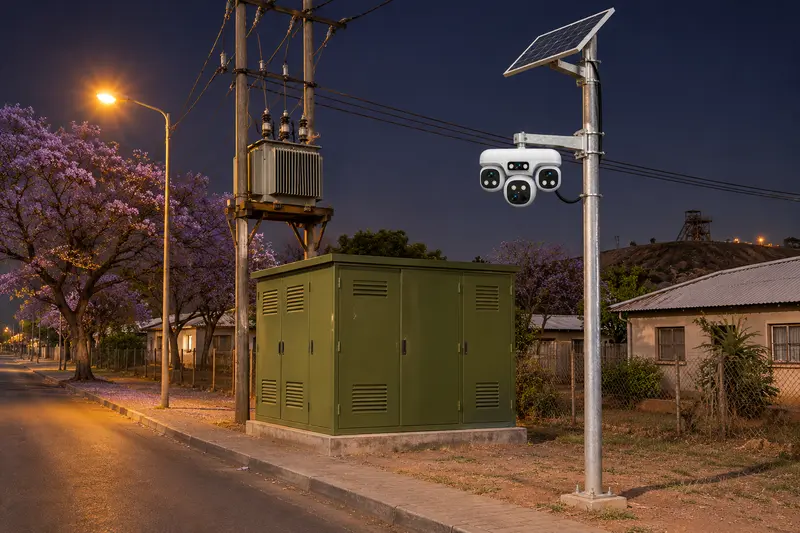
- Kiosk or mini-substation: the multi-lens solar 4G camera (SQ41), three pan-tilt heads and a fixed lens on a 12,000 mAh battery, covering the kiosk and both directions of the road from one pole.
- Single gate or cable route: the solar 4G PTZ camera (S49), with a separate 5 W panel and a built-in siren.
A camera does not replace policing or the enforcement against scrap buyers that the SAHRC has called for.[3] Read our summary of what the SAHRC said about copper cable theft, and our guide to farm security cameras for stock theft.
For installers, security companies and community groups
We are the factory and sell from 100 units, mixed models allowed, in US dollars FOB China. Our models do not hold ICASA type approval yet; the South African importer applies, and we supply the test reports. Local prices are on the 4G solar camera with SIM card price in South Africa page, and bands on the South Africa page.
Questions
Does CCTV reduce cable theft?
In Phalaborwa, the organisation that installed 11 camera stations says cable theft has virtually stopped in the covered areas.[2] Cameras work best when alerts reach someone who can respond.
Can a solar camera work at night next to a kiosk?
Yes. It runs from the battery the panel charged in the day and records with infrared or its spotlight. Mount it on its own pole, out of reach.
Sources
- Cable thieves cost Joburg R236m as one in five power outages linked to crime. IOL, 29 Oct 2026. Read 3 Nov 2026.
- Phalaborwa First installs 11 CCTV cameras as cable theft declines. Letaba Herald (The Citizen), 2 Nov 2026. Read 3 Nov 2026.
- It’s a human rights crisis, SAHRC says of copper cable theft. Sowetan, 22 Sept 2026. Read 27 Oct 2026.
More articles
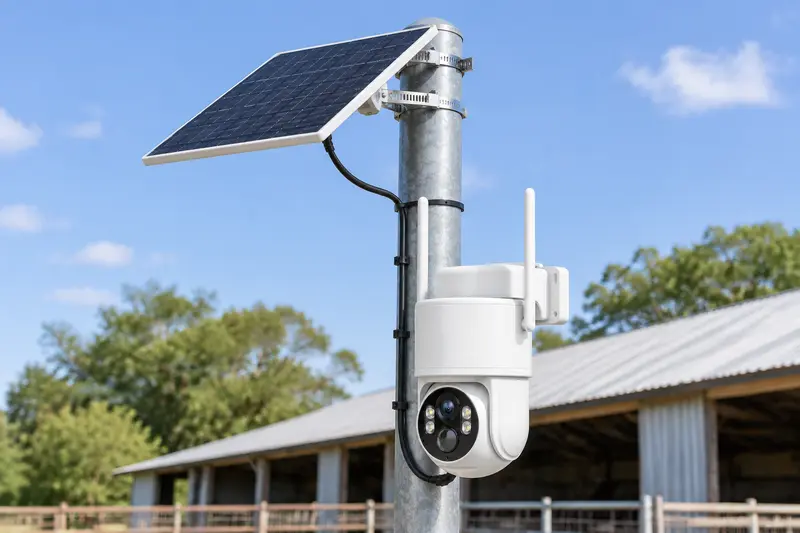
How to mount a separate solar panel for a CCTV camera
How to mount a solar panel for a CCTV camera: where it goes on the pole, which way it faces, the tilt, clamping, cable routing, drip loop and panel sizes per model.
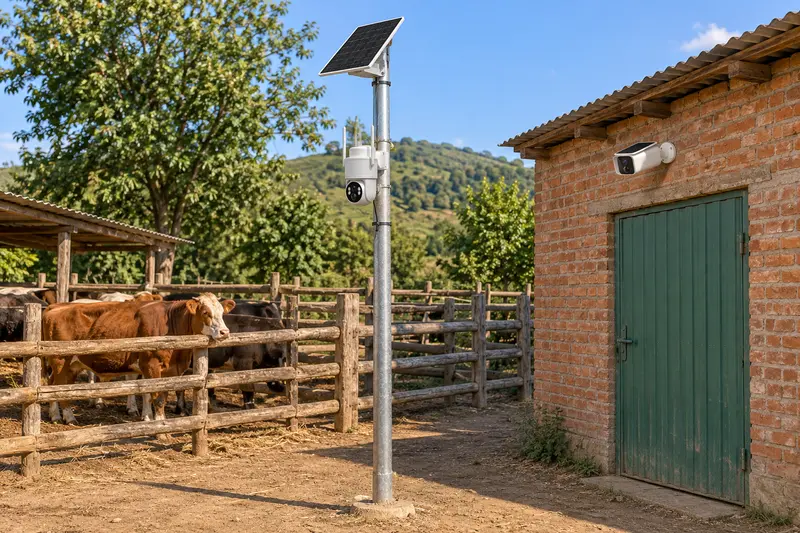
PTZ vs bullet camera on a farm: which solar 4G camera goes where
PTZ vs bullet camera on a farm: how a pan-tilt S49 and a fixed S26 bullet differ in view, night range, solar panel and price, and which suits a gate, a pen or a store.
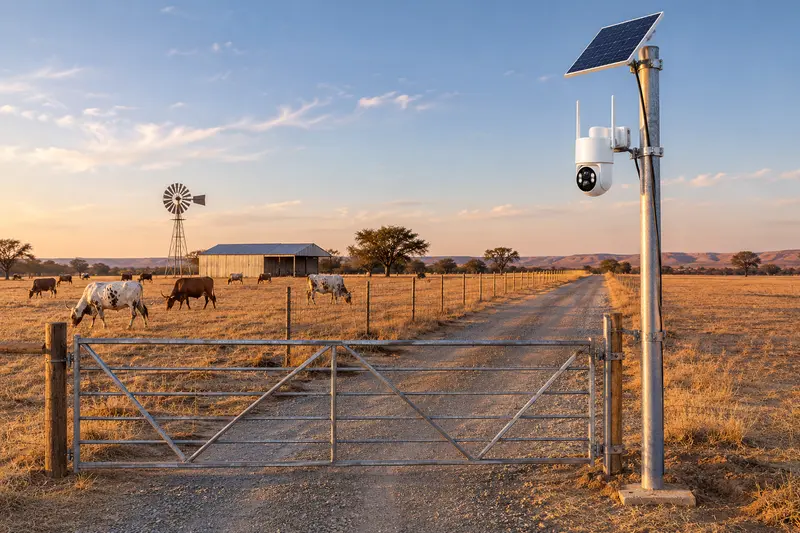
Farm security systems in South Africa: solar 4G PTZ cameras without Wi-Fi
Farm security systems in South Africa: why livestock theft and cable theft now matter more than load shedding, and how solar 4G PTZ cameras watch gates, kraals and pumps.