Article ·
Stock theft in Australia: 4G solar cameras for farms without WiFi
Stock theft in Australia is often found out weeks or months after it happens. In NSW, police say 120 Merino ewes went missing from a property at Leadville, east of Dubbo, some time between April 2025 and September 2026. In Queensland, a woman was charged after 100 head of cattle, a tractor and 4 km of fencing went missing from a farm at Boondooma over three years. This article looks at why stock theft is so hard to catch, where a 4G solar camera on a SIM card helps on a farm with no WiFi, and what resellers need to know about the ACMA and the new smart-device security rules.
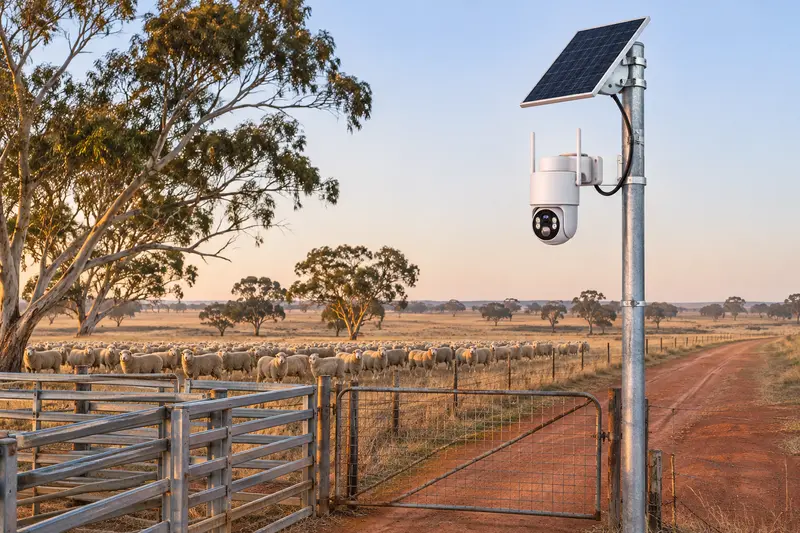
Two recent cases
| Where | What was taken | When it was found out |
|---|---|---|
| Leadville, NSW central west | 120 Merino ewes, mixed age, in full wool[1] | Missing at some point between April 2025 and September 2026 |
| Boondooma, South Burnett, Qld | 100 head of cattle, a tractor and 4 km of barbed-wire fencing, worth more than $280,000 in total[2] | Reported in May 2026; police allege it happened over three years |
Merino ewes were worth $250 to $380 a head at auction, according to the same 9News report, which also recalled 5,500 sheep stolen near Blackall in Queensland’s central west earlier in 2026.[1] In the Boondooma case police allege the accused had access to the property; the stolen tractor and fencing were found at another address.[2]
Why stock theft is so hard to catch
9News quoted criminologist Kyle Mulrooney of the University of New England: livestock on large properties may not be checked for weeks, so an owner often cannot say when a theft happened, and Australia has no consistent national data on stock theft.[1] The report also notes that gates, lighting and cameras cannot realistically cover thousands of hectares.
That is the honest limit: no camera watches a whole station. What it can watch are the few places animals have to pass to leave the property: the yards, the loading ramp, the gate onto the road and the station track. Thieves need a truck or a trailer, and trucks use gates.
Where a 4G solar camera helps
- No WiFi, no power at the yards. A 4G solar camera runs from its own panel and battery and sends alerts over a data SIM, so it works at a set of yards 10 km from the homestead.
- Alerts at night, not discoveries months later. When it sees a person or vehicle at the yards or the gate, it sends a notification to your phone with a clip, and records to the microSD card (up to 128 GB).
- Evidence of the vehicle. Police appeals usually ask for footage of vehicles; a camera aimed along the track at the gate records the truck, the trailer and the time.
- A siren as a deterrent. The S49 and SQ62 have built-in sirens that can sound when someone approaches.
Which camera for which spot
- Station gate or track: the solar 4G PTZ camera (S49), with a separate 5 W panel clamped at the top of the pole in full sun and a 7,800 mAh battery.
- Yards and loading ramp: the dual-lens solar 4G camera (SQ62), one lens fixed on the ramp, the other following movement.
- Large yards or a shed with machinery: the multi-lens solar 4G camera (SQ41), three pan-tilt heads and a fixed lens on a 12,000 mAh battery.
Setting up on a property
- Check Telstra or Optus at the pole.Use a phone on the same network at camera height. Telstra and Optus both list B28 (700 MHz), the low band that reaches furthest from a tower, and our band version A supports it.[5]
- Its own pole, about 4 m up.Out of reach, panel clamped at the top facing north, clear of tree shade.
- Aim at the way out.The gate onto the road and the track to the yards, not the open paddock.
- Tight detection zones.Leave out the road and moving trees so alerts at 2 am mean something.
- Share the alerts.Owner, manager and a neighbour, so someone always sees them.
More set-ups are on the livestock security page and the Australia page.
For resellers and installers: ACMA and the smart-device rules
We are the factory and sell from 100 units, mixed models allowed, in US dollars FOB China. Two sets of rules matter before you sell in Australia:
- ACMA labelling.A supplier of devices covered by an ACMA labelling notice registers on the national EESS database as the responsible supplier and labels the device with the RCM; in practice that is the Australian importer.[4] Our models are not RCM-labelled yet, and we have not confirmed which ACMA standards apply to each model: check with the ACMA or an accredited lab before the first shipment.
- Security standards for smart devices.Since 4 March 2026 the Cyber Security (Security Standards for Smart Devices) Rules 2025 apply to most smart devices acquired in Australia by a consumer. They require no universal default passwords, a published way to report security issues, and published information on how long the device will get security updates.[3] If you sell to consumers, ask us for the password and update details for the exact model with your quote; we have not yet confirmed a published support period for each model.
Questions farmers ask
Does a 4G farm camera need WiFi?
No. It sends alerts and live video over a mobile data SIM and records to its own microSD card.
Will it work through a run of cloudy days?
It runs at night and in cloud from the battery the panel charged. In long cloudy spells, motion-triggered recording makes the battery last longer than continuous recording.
How much data does it use?
Mostly when you watch live video. See how much data a 4G camera uses.
Sources
- Flock of 120 Merino sheep stolen from NSW central west property. 9News, 26 Oct 2026. Read 4 Nov 2026.
- Accused cattle rustler charged after 100 cows go missing. InDaily Queensland, 30 Jun 2026. Read 4 Nov 2026.
- Security Standards for Smart Devices. Department of Home Affairs (Australia). Read 4 Nov 2026.
- ACMA requirements: use of the RCM. Electrical Equipment Safety System (EESS). Read 29 Oct 2026.
- List of LTE networks (Oceania section). Wikipedia. Read 29 Oct 2026.
More articles
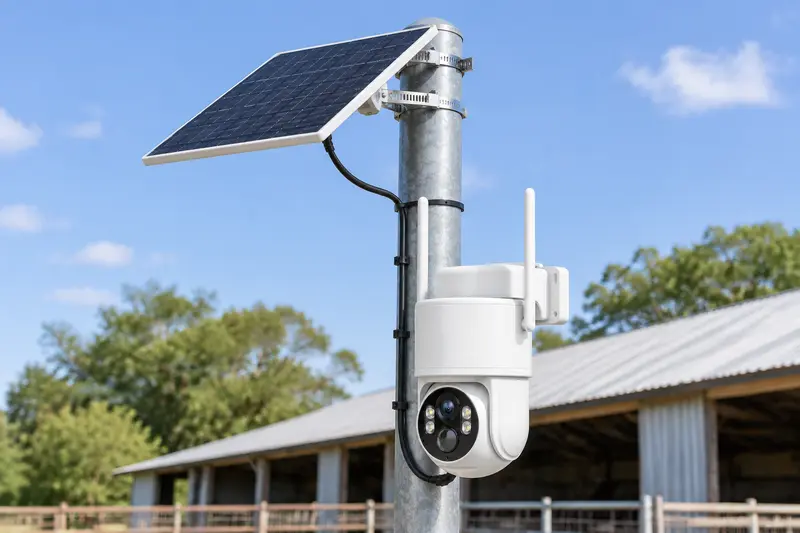
How to mount a separate solar panel for a CCTV camera
How to mount a solar panel for a CCTV camera: where it goes on the pole, which way it faces, the tilt, clamping, cable routing, drip loop and panel sizes per model.
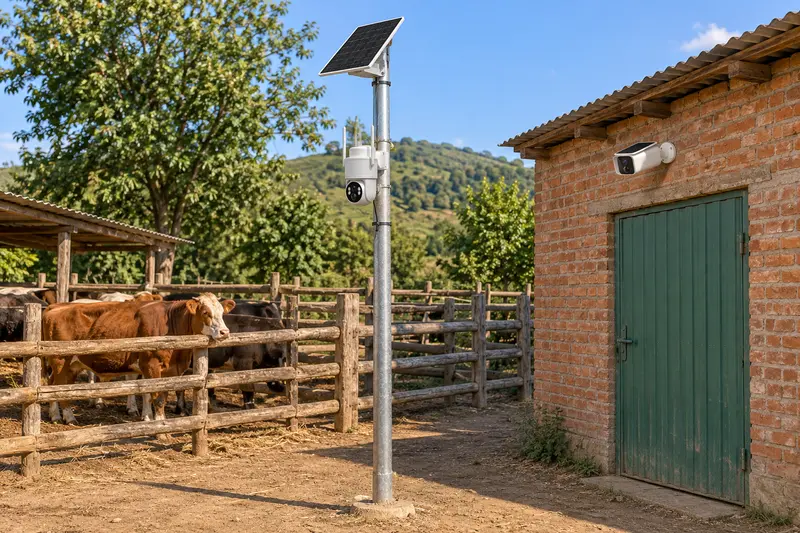
PTZ vs bullet camera on a farm: which solar 4G camera goes where
PTZ vs bullet camera on a farm: how a pan-tilt S49 and a fixed S26 bullet differ in view, night range, solar panel and price, and which suits a gate, a pen or a store.
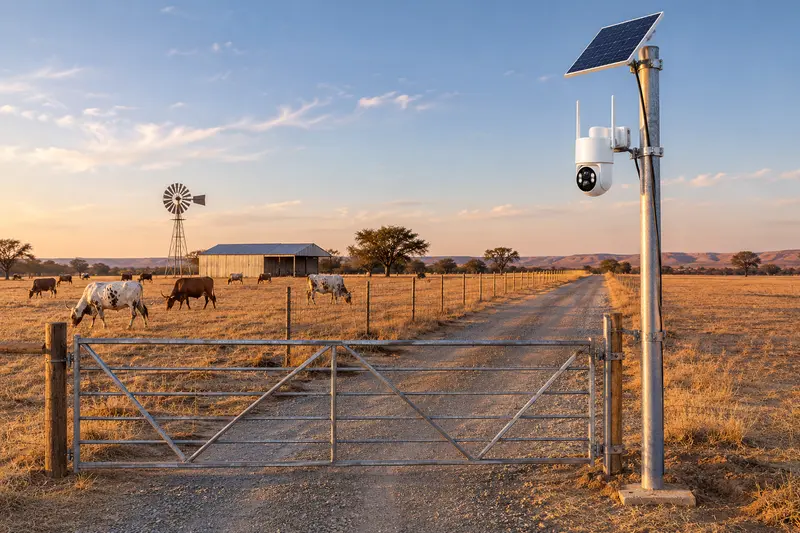
Farm security systems in South Africa: solar 4G PTZ cameras without Wi-Fi
Farm security systems in South Africa: why livestock theft and cable theft now matter more than load shedding, and how solar 4G PTZ cameras watch gates, kraals and pumps.